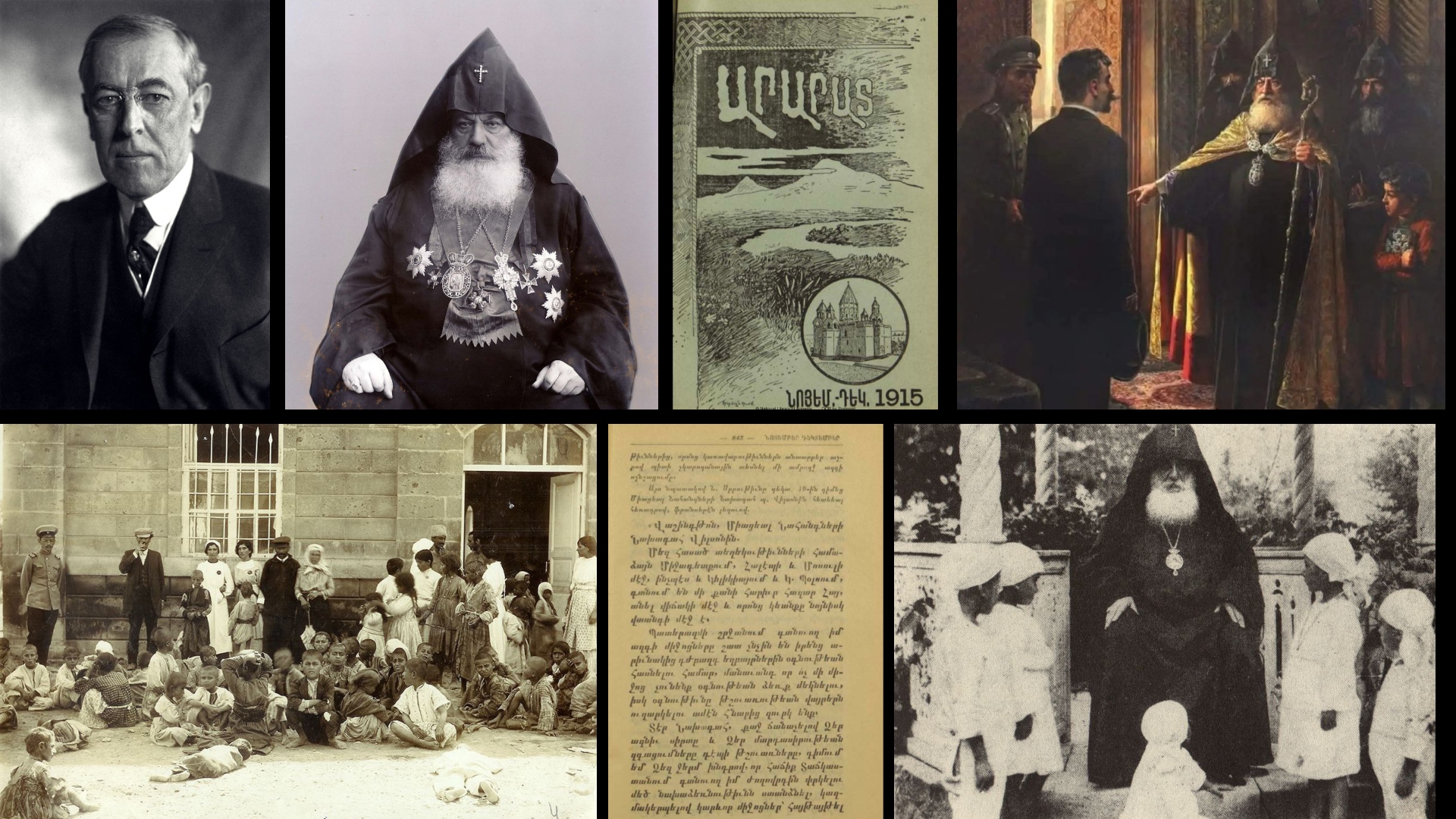
The Armenian news outlet 168.am recently published an article[1] presenting a letter, dated 19 December 1915, from Catholicos of Etchmiadzin Gevorg V Surenyants to US President Woodrow Wilson, asking him to help the Armenian refugees. The full text of the letter is presented after a brief introduction and a short conclusion follows the main body of the letter. The letter is a plea of help for the Armenian refugees who fled the Ottoman State during the 1914-1915 period.
The introduction notes that “Catholicos Gevorg V Surenyants was doing everything he could to help his people during that period.” The conclusion similarly highlights that “Holy Etchmiadzin became not only a spiritual center, but also a pillar of national salvation, accepting the first and heaviest wave of refugees.” And in so doing, the article travels a well-trodden path of the Armenian national(ist) narrative which almost entirely lacks critical self-reflection.
In its efforts to praise the Catholicos and Armenian Apostolic Church, the article conveniently overlooks that it was the Catholicos himself who spearheaded and blessed the Armenian volunteer movement that was a major cause of the catastrophe that engulfed the region. He promised Russian authorities that Ottoman Armenians would support them by rebelling behind the Ottoman lines, while also calling on Armenians launch their crusade and exhorting them to wreak vengeance on the Muslims.
The result was that from the earliest period of the First World War, the Armenian bands both with the Russian army and behind Ottoman lines engaged in massive violence against the Muslims in the towns and cities they occupied. This undoubtedly pitted Muslims and Armenians against each other. Moreover, given the fact that the operations of the Russian army were not always successful and there were constant advances and withdrawals in the front, it was self-defeating for the Armenian bands to engage in this sort of behavior since Russian withdrawals would bring retaliation from the Muslims and cause Armenians to flee and endure hardships as they did.
Beyond the moral and spiritual problems associated with his attitude, the Catholicos was extremely reckless with the well-being of his people. By offering the service of his people to Tsarist Russia, he in effect placed the Ottoman Armenian population as pawns to be used and exploited. Even after the disaster struck the Ottoman Armenian population, the Catholicos did not seem to have learned the lessons of history and continued to use the suffering his people for political purposes. Commenting on this, an Armenian historian notes the following: “the tactic of engaging the United States in war by way of Armenian issue was considered equally by Russia. Russian encouragement of the Catholicos to appeal to the president of the United States is evidence of its desire to involve both countries in the war.” In other words, just as the Ottoman Armenians were used to serve Russian aims before and during 1915, their sufferings were used to serve Russia as well.
A sane and calmer approach, befitting a spiritual leader, would have been to promote peace, tranquility and mutual respect to the benefit of both Muslims and Armenians. Unfortunately, Catholicos Kevork V Surenyants did not act in such a spirit during the war. His references to Turks as “Tajiks” and Türkiye as “Tajikistan” reveal that he was not free of the prejudices that Armenian nationalists harbored for decades and certainly played an important role on the road to the tragedy.
*Picture: 168.am
© 2009-2025 Center for Eurasian Studies (AVİM) All Rights Reserved
















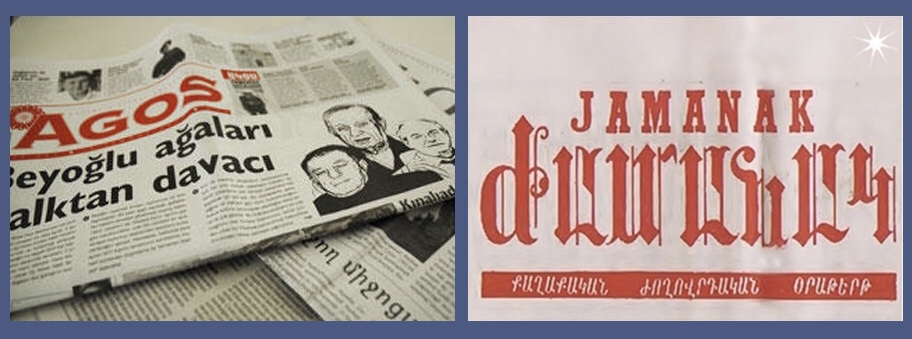 THE LAST ACT IN THE DUEL BETWEEN JAMANAK AND AGOS
 LEGAL AND STRATEGIC APPROACHES AGAINST GENOCIDE ALLEGATIONS: ESTABLISHING A MIDDLE PATH
 TENSION OVER THE LACHIN CORRIDOR BETWEEN AZERBAIJAN AND ARMENIA
 THE INDEPENDENT LETS FISK TO ABUSE HISTORICAL FACTS AGAIN
 GREEK DEFENSE MINISTER DENDIAS'S STATEMENT REGARDING THE "GREEK CHRISTIAN IDENTITY" OF THE DODECANESE ISLANDS REFLECTS A CRUSADER MENTALITY
 DISCUSSIONS ON KARABAKH AT THE UNSC AND ITS REPERCUSSIONS IN SOME CIRCLES
 BOOK REVIEW: THE ARARAT ILLUSION – DAVID D. MINIER
 A PUBLIC CONVERSATION WITH ULUÇ GÜRKAN ON MALTA TRIBUNALS