














This is the English translation of a Turkish language article that was originally published by AVİM on 29 January 2026.
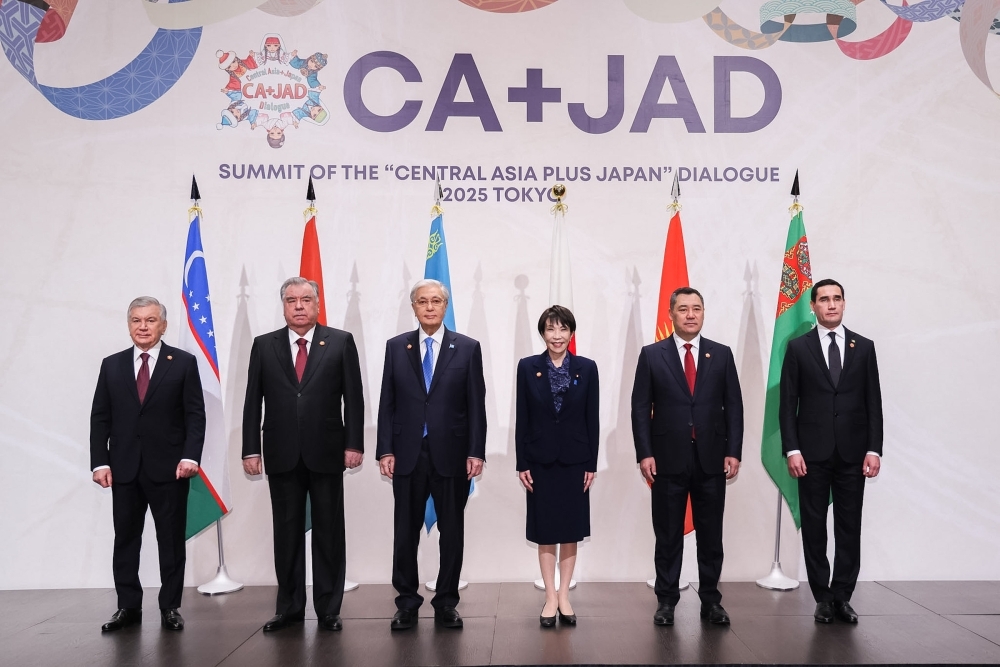
On 20 December 2025, the heads of state of Japan and five Central Asian countries held their first leaders’ summit in Tokyo. This signals a new phase in Japan’s relations with Central Asian states. In 2004, Japan launched the “Central Asia Plus Japan Dialogue” in Astana to improve regional cooperation with the Central Asian states. Japan thus pioneered a diplomatic approach that comprehensively addresses relations with Central Asian states in terms of regional integration.[1] Under the framework of Central Asia Plus Japan Dialogue referred as CA+JAD, nearly 40 meetings have been held to date and the discussions initiated in the fields of economic cooperation have expanded to cover areas such as security, energy, transportation, counterterrorism, and the environment. CA+JAD summit held in Tokyo on 20 December 2025 is significant in that it demonstrates that aforementioned relations have been elevated to the level of heads of state. In her speech at the summit, Japanese Prime Minister Takaichi highlighted the geostrategic importance of Central Asia. She also announced the launch of “CA+JAD Tokyo Initiative.”[2] It has been stated that Tokyo Initiative is built on three key areas of cooperation: Green (Transformation) and Resilience, Connectivity, and Human Resource Development.[3] The “Declaration of Tokyo” was signed at the end of the summit, which includes Japan’s 19-million-dollar investment plan covering various areas. For Japan, which has recently been interested in the Middle Corridor transportation routes and has been investing in various sectors in the region’s countries, transportation routes and critical minerals emerged as key topics at the Tokyo summit.
Although Japan’s interest in Central Asia dates back to the early 2000s, its elevation to the level of heads of state reflects a broader global trend that emphasize the region’s geostrategic importance. This global trend is related to the economic, political, diplomatic, and security relations that global and regional actors have recently developed with Central Asian states. By 2025, actors such as the US, the EU, and China have made significant progress in developing comprehensive relations with Central Asian states. It is evident that these actors are approaching their relations with Central Asia from a regional and comprehensive perspective. The most major of these developments are the summits held by the EU, the US, and China in recent years. In April 2025, the EU held its first summit with Central Asian countries, bringing leaders together in Samarkand. The EU published its first strategy document on Central Asian countries in 2007, and announced the “Joint Roadmap for Deepening Ties between the EU and Central Asia” in 2023.[4] At the Samarkand summit, the EU included Central Asian countries in its Global Gateway Project, announced in 2021, which is claimed to be an alternative to China’s Belt and Road Initiative. Investments in Trans-Caspian transport corridors and regional connectivity formed the main agenda at the Samarkand summit.
China’s interest in Central Asia is steadily increasing. According to 2025 data, China has become the primary trading partner of Central Asian countries.[5] Transportation lines, infrastructure investments, digital and green investments under the Belt and Road Initiative announced by China in 2013 have been key factors in increasing China’s presence in the region. Meanwhile, within its institutionalized regional relations through the Shanghai Cooperation Organization, China launched the “C5+C” cooperation model with five Central Asian states in 2020.[6] The second summit of the C5+C dialogue, which was elevated to level of heads of state in 2023, took place in 2025. Topics such as the Belt and Road Initiative, digital and green investments, free trade were discussed at the Astana Summit, and important transportation projects aimed at increasing regional connectivity, particularly the China-Uzbekistan railway project, were targeted.[7]
The Central Asia region, which was initially important for the US in terms of its Afghanistan policy, has become prominent in recent years in areas including transportation, energy, and politics. In this context, the US launched the “C5+1 Dialogue Forum” with five Central Asian states in 2025 and published the document titled “United States Strategy for Central Asia 2019-2025”. In 2023, “C5+1” mechanism was elevated to the level of heads of state, and the first summit was held in Washington in November 2025. Among the main agenda items of the US’ recent Central Asia policy have been the critical minerals and rare earth elements. To this end, “C5+1 Critical Minerals Dialogue” was established in 2024, and various agreements on critical elements were signed with Central Asian countries at the 2025 C5+1 Washington Summit. Another development is the US’ initiative to implement the Zangezur Corridor in the form of the “Trump Route for International Peace and Prosperity.”[8]
In addition to China, the US, the EU, and Japan’s the growing interest in Central Asia, actors such as the Gulf states and India are also developing cooperation with countries in the region. In this context, it can be observed that the geopolitical importance of Central Asia is increasing. The factors playing a role in the increased interest of aforementioned actors in the region are based on three main components. The first component relates to “connectivity.” In this regard, the Middle Corridor (Trans-Caspian cooperation), which refers to the transport route extending from Central Asian states to Europe via Türkiye, facilitating transportation between Europe and Asia within the scope of China’s Belt and Road Initiative, has gained strategic importance in terms of transportation and connectivity as an alternative route that is preferred over the Northern Corridor, which has become unusable due to the Russia-Ukraine War. The second component relates to energy and mineral resources. Central Asian countries, which are rich in energy resources, particularly natural gas, are also rich (in the case of Kazakhstan, Tajikistan, and Kyrgyzstan) in rare earth elements and critical minerals such as uranium and lithium, and have gold resources (in the case of Uzbekistan). This makes them stand out in terms of nuclear and green energy resources, in addition to natural gas, and attracts foreign investment.[9] Recent agreements in the aforementioned areas between the EU, the US, China, and Japan are key indicators of this situation.
Finally, the diversification of foreign policies of Central Asian countries, primarily Kazakhstan, in line with the concept of regionalization, and the increasing strategic interest in the region are turning Central Asia into an element of geopolitical competition.[10]
In addition to the components mentioned above, several developments have taken place that have advanced regional integration among Central Asian states, increasing the geopolitical importance of Central Asia. The first of these is the resolution of the border dispute between Kyrgyzstan and Tajikistan, which led to the signing of a peace agreement on 13 March 2025, and signing of the Khujand Treaty between Kyrgyzstan, Uzbekistan, Tajikistan to demarcate their borders on 31 March 2025. This represents a significant achievement in terms of regional peace and security. The second development is the agreement to implement the Zangezur Corridor in the form of the “Trump Route for International Peace and Prosperity” under the leadership of the US. This would facilitate transportation and strengthen connectivity between Türkiye, Central Asia, and the South Caucasus countries. Meanwhile, the proposal to establish a Central Asian Community, made by the Uzbek leader during the Consultative Meeting of the Heads of States of Central Asia in November 2025, signals the emergence of a spirit of unity among the countries of the region. At the same summit, Azerbaijan’s inclusion as a full member of the Consultative Meeting of the Heads of States of Central Asia has enhanced Azerbaijan’s integration with the Central Asia region and brought to the agenda the possibility of the transformation of the C5 mechanism into the C6.[11] This has naturally strengthened the connection between Azerbaijan and Central Asia.
Furthermore, the Organization of Turkic States (OTS) and the “Turkic World Vision 2040” that was adopted in 2021 represent the most advanced institutional dimension of integration among Central Asian states. The steps toward integration among the Turkic states led by Türkiye have made significant contributions to the establishment of common strategic goals among Central Asian states.
As a result, Central Asia has gained geostrategic importance due to the Middle Corridor gaining significance as an alternative route, as well as the region’s connectivity and possession of resources such as natural gas, critical minerals, and rare earth elements. Actors such as the US, China, the EU, and Japan have pursued a comprehensive approach in their relations with the five Central Asian states, advancing their integrated relations with Central Asia over time through various dialogue mechanisms and elevating them to the level of heads of state. On the other hand, the resolution of border issues between the countries in the region, the establishment of institutional integration and common visions through the OTS have enabled the strengthening of regional integration. The convergence of these factors has made Central Asia a geopolitically and geoeconomically strategic region that is increasingly attracting the attention of actors such as the US, China, the EU, and Japan.
*Image: Ministry of Foreign Affairs of Japan
[1] “Strengthening Ties with Central Asian Nations an Imperative for Japan”, Japan Forward, December 26, 2025, https://japan-forward.com/strengthening-ties-central-asian-nations-an-imperative/
[2] Bahtiyar Abdülkerimov, “Orta Asya-Japonya diyaloğu, liderler zirvesiyle yeni bir döneme giriyor”, Anadolu Agency, December 19, 2025, https://www.aa.com.tr/tr/dunya/orta-asya-japonya-diyalogu-liderler-zirvesiyle-yeni-bir-doneme-giriyor/3775429 ; Vusal Guliyev ,“Japan Deepens Cooperation with Central Asian States” Jamestown, January 26, 2026, https://jamestown.org/japan-deepens-cooperation-with-central-asian-states/
[3] “The Summit of the "Central Asia plus Japan" Dialogue (CA+JAD)”, Ministry of Foreign Affairs of Japan, December 20, 2025, https://www.mofa.go.jp/erp/ca_c/pageite_000001_01438.html
[4] “The EU and Central Asia: A Growing Partnership with Potential and Ambition”, The Diplomatic Service of the European Union, February 18, 2025, https://www.eeas.europa.eu/eeas/eu-and-central-asia-growing-partnership-potential-and-ambition_en ; “Joint Roadmap for Deepening Ties Between the EU and Central Asia”, Council of the European Union, October 23, 2023, https://data.consilium.europa.eu/doc/document/ST-14587-2023-INIT/en/pdf
[5] Emre Aytekin, “Çin'in Orta Asya Ülkeleri ile Ticaret Hacmi 2025'te 100 Milyar Doları Aştı”, Anadolu Agency, January 19, 2026, https://www.aa.com.tr/tr/ekonomi/cinin-orta-asya-ulkeleri-ile-ticaret-hacmi-2025te-100-milyar-dolari-asti/3804147
[6] He Yin, “Xi'an Summit a New Milestone in China-Central Asia Relations”, People’s Daily, May 23, 2023, https://en.people.cn/n3/2023/0523/c90000-20022316.html
[7] "Full Text of Xi's Keynote Speech at Second China-Central Asia Summit", Xinhua, June 18, 2025, https://english.news.cn/20250618/8d15248700c5498f817102af488d2666/c.html
[8] “United States Strategy for Central Asia 2019-2025”, U.S. Department of State, 2019, https://tj.usembassy.gov/wp-content/uploads/sites/143/United-States-Strategy-for-Central-Asia-2019-2025-1.pdf ; "Minerals Security Partnership", U.S. Department of State, https://www.state.gov/minerals-security-partnership ;
[9] Asma Siddiq, “Issue Brief on “Central Asia-Japan Summit 2025: Japan’s Strategic Re-Engagement with Central Asia”, ISSI, January 12, 2026, https://issi.org.pk/issue-brief-on-central-asia-japan-summit-2025-japans-strategic-re-engagement-with-central-asia/
[10] Melih Demirtaş, "C5+1’den İbrahim Anlaşmaları’na: ABD Realitesi ve Bölgesel Nüfuz Siyaseti", Tercüman, November 25, 2025, https://www.tercuman.com/analiz/c51den-ibrahim-anlasmalarina-abd-realitesi-ve-bolgesel-nufuz-siyaseti-1341 ;
[11] Robert M. Cutler, “Azerbaijan Joins Central Asia to Build a C6 Corridor Core”, Times of Central Asia, November 17, 2025, https://timesca.com/azerbaijan-joins-central-asia-to-build-a-c6-corridor-core/
© 2009-2025 Center for Eurasian Studies (AVİM) All Rights Reserved
No comments yet.
-
 THE 16TH BRICS SUMMIT REGARDING CHINA AND THE GLOBAL SOUTH
Seyda Nur OSMANLI 26.12.2024 -
 TÜRKİYE’S ASEAN DIALOGUE PARTNERSHIP
Seyda Nur OSMANLI 26.08.2026 -
 CHINA’S GROWING PRESENCE IN GEORGIA
Seyda Nur OSMANLI 30.04.2025 -
 HIGHLIGHTS FROM THE US PRESIDENT TRUMP’S ASIA TRIP
Seyda Nur OSMANLI 29.01.2026 -
 TURKIYE-CHINA RELATIONS: OPPORTUNITIES AND CHALLENGES
Seyda Nur OSMANLI 22.11.2024
-
 THE GRAIN INITIATIVE AND THE BLACK SEA SECURITY - II
Turgut Kerem TUNCEL 03.08.2023 -
 AN ANALYSIS OF THE POLITICS IN ARMENIA AFTER THE “VELVET REVOLUTION”
Turgut Kerem TUNCEL 01.06.2018 -
 1934 PACT OF BALKAN ENTENTE: THE PRECURSOR OF BALKAN/SOUTHEAST EUROPE COOPERATION
Teoman Ertuğrul TULUN 06.08.2020 -
 TAIWAN’S SOVEREIGNTY AND “ONE CHINA” DILEMMA
Şevval Beste GÖKÇELİK 19.12.2022 -
 ABUSING SRI LANKA TERRORIST ATTACKS TRAGEDY AS A PRETEXT FOR PROPAGATING FALSE GENOCIDE CLAIMS
Teoman Ertuğrul TULUN 29.04.2019
-
25.01.2016
THE ARMENIAN QUESTION - BASIC KNOWLEDGE AND DOCUMENTATION -
12.06.2024
THE TRUTH WILL OUT -
27.03.2023
RADİKAL ERMENİ UNSURLARCA GERÇEKLEŞTİRİLEN MEZALİMLER VE VANDALİZM -
17.03.2023
PATRIOTISM PERVERTED -
23.02.2023
MEN ARE LIKE THAT -
03.02.2023
BAKÜ-TİFLİS-CEYHAN BORU HATTININ YAŞANAN TARİHİ -
16.12.2022
INTERNATIONAL SCHOLARS ON THE EVENTS OF 1915 -
07.12.2022
FAKE PHOTOS AND THE ARMENIAN PROPAGANDA -
07.12.2022
ERMENİ PROPAGANDASI VE SAHTE RESİMLER -
01.01.2022
A Letter From Japan - Strategically Mum: The Silence of the Armenians -
01.01.2022
Japonya'dan Bir Mektup - Stratejik Suskunluk: Ermenilerin Sessizliği -
03.06.2020
Anastas Mikoyan: Confessions of an Armenian Bolshevik -
08.04.2020
Sovyet Sonrası Ukrayna’da Devlet, Toplum ve Siyaset - Değişen Dinamikler, Dönüşen Kimlikler -
12.06.2018
Ermeni Sorunuyla İlgili İngiliz Belgeleri (1912-1923) - British Documents on Armenian Question (1912-1923) -
02.12.2016
Turkish-Russian Academics: A Historical Study on the Caucasus -
01.07.2016
Gürcistan'daki Müslüman Topluluklar: Azınlık Hakları, Kimlik, Siyaset -
10.03.2016
Armenian Diaspora: Diaspora, State and the Imagination of the Republic of Armenia -
24.01.2016
ERMENİ SORUNU - TEMEL BİLGİ VE BELGELER (2. BASKI)
-
AVİM Conference Hall 24.01.2023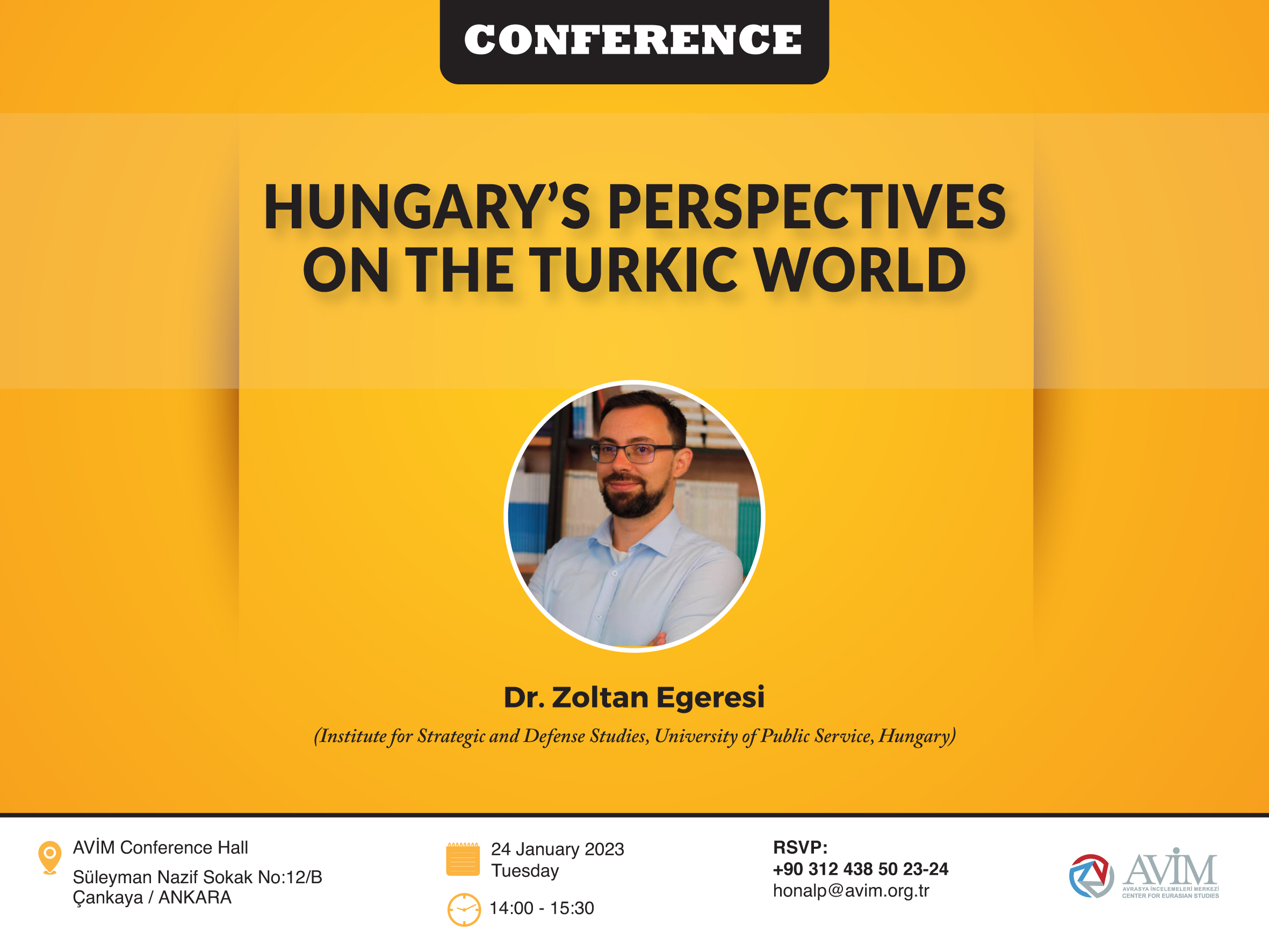
CONFERENCE TITLED “HUNGARY’S PERSPECTIVES ON THE TURKIC WORLD"