













Dear Readers,
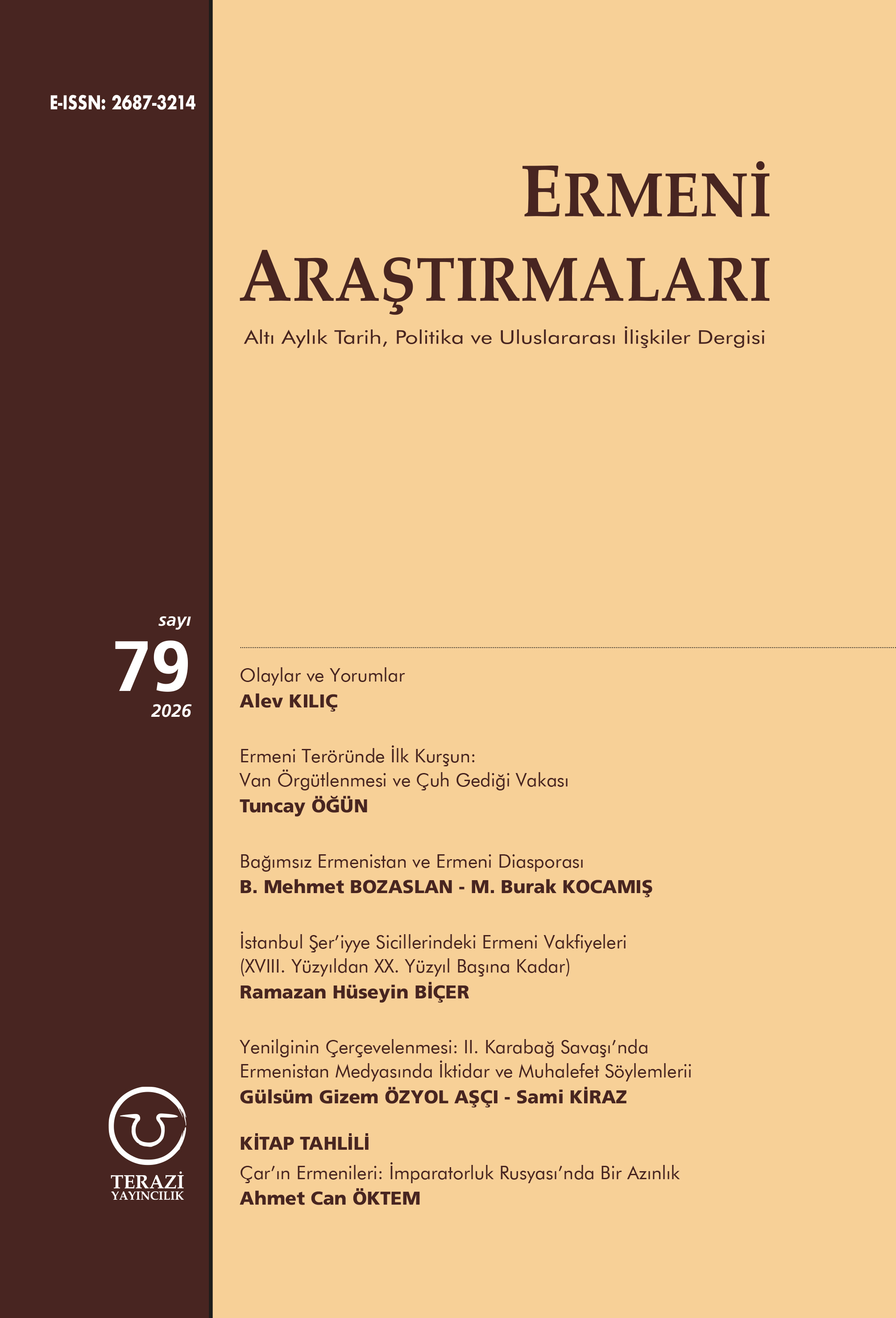
We are pleased to once again meet with our esteemed readers in the 79th issue of The Ermeni Araştırmaları. In addition to the editorial article, which constitutes one of the traditional elements of our journal, this issue includes four research articles and one book review.
The studies featured in our 79th issue aim to contribute new perspectives to academic discussions in the field of Armenian studies through their methodological approaches and thematic focuses. Drawing upon different disciplines, these contributions enable both historical and contemporary issues to be evaluated in a multidimensional manner while also bringing a critical and analytical perspective to the existing literature.
In the editorial article titled “Facts and Comments” (“Olaylar ve Yorumlar”), one of the traditional sections of our journal, Alev Kılıç presents a comprehensive evaluation of the period between November 2025 and April 2026. Within this framework, domestic political developments in Armenia, the country’s foreign policy orientations, the peace agreement process with Azerbaijan, as well as Türkiye–Armenia relations and the normalization process are examined from a multidimensional perspective. Developments during this period appear to have been largely shaped by the parliamentary elections announced for June 7. The administration led by Nikol Pashinyan, with the political support of the United States and the European Union, has adopted a peace-oriented approach that relatively distances itself from historical rhetoric, seeks to establish good relations with neighboring countries, and prioritizes closer ties with the West. In contrast, the pro-Russian opposition led by the country’s three former presidents has remained largely ineffective, while the role of opposition has increasingly been assumed by a newly emerging political formation shaped by the Armenian Apostolic Church, which advocates traditional narratives, and businessman Samvel Karapetyan, who is associated with this formation. In this context, alongside the geopolitical rivalry between Russia and the West, the support extended to the Apostolic Church by various actors on the basis of religious solidarity reveals the multilayered nature of Armenia’s domestic politics.
The first research article of our 79th issue is Tuncay Öğün’s study titled “The First Shot in Armenian Terrorism: Organizational Structures in Van and the Çuh Gediği Incident” (“Ermeni Teröründe İlk Kurşun: Van Örgütlenmesi ve Çuh Gediği Vakası”). The article examines the organizational dynamics in Van during the late nineteenth century and the Çuh Gediği Incident of 1889. While addressing the influence of Mkrtich Khrimian and Mkrtich Portukalian on the founding process of the Armenagan Party and its adoption of armed struggle, the study evaluates the incident within the context of political and organized acts of violence.
The second article, titled “Independent Armenia and the Armenian Diaspora” (“Bağımsız Ermenistan ve Ermeni Diasporası”), is authored by B. Mehmet Bozaslan and M. Burak Kocamış. The study examines Armenia’s post-independence political development through the dual axis of the state and the diaspora. Within the framework of leadership periods extending from Levon Ter-Petrosyan to Nikol Pashinyan, the major challenges faced by the country in domestic and foreign policy are analyzed. In addition, the global role of the Armenian diaspora, particularly in the United States, Russia, and France, is evaluated. In this regard, the study demonstrates the decisive influence of state–diaspora interaction in shaping Armenian politics.
The third article, authored by Ramazan Hüseyin Biçer and titled “Armenian Waqfiyahs in Istanbul Sharia Court Records (From XVII. Century Until the Beginning of XX. Centuries)” (“İstanbul Şer‘iyye Sicillerindeki Ermeni Vakfiyeleri (XVIII. Yüzyıldan XX. Yüzyıl Başına Kadar)”), examines the charitable foundation activities of the Armenian community, which maintained its existence within the Ottoman Empire for many years under dhimmi status. Drawing upon waqfiyah deed texts found in the Istanbul Sharia Court Registers, the study analyzes these foundations in terms of their charitable conditions, modes of establishment, spatial distribution, and types of foundations. Furthermore, through institutional structures such as churches and schools mentioned in the waqfiyah deeds, the study also sheds light on the social and political developments of the period. In this respect, the article offers an original contribution to the literature by examining a relatively underexplored field through a holistic approach.
The fourth research article, titled “Framing Defeat: Government and Opposition Narratives in Armenian Media During the Second Karabakh War” (“Yenilginin Çerçevelenmesi: II. Karabağ Savaşı’nda Ermenistan Medyasında İktidar ve Muhalefet Söylemleri”), is authored by Gülsüm Gizem Özyol Aşçı and Sami Kiraz. This study examines the reflections of the Second Karabakh War in the Armenian press through media discourses. By comparatively analyzing the differing narratives of pro-government and opposition media outlets regarding the war, defeat, and peace processes, the study reveals that pro-government discourses sought to produce legitimacy through emphases on “national unity” and “external threat,” whereas opposition discourses criticized the Nikol Pashinyan administration on the basis of strategic failure and crisis of legitimacy. Drawing on framing theory and critical discourse analysis, and employing qualitative content analysis together with Fairclough’s three-dimensional model, the study demonstrates that media discourses not only convey events but also play a decisive role in the interpretation of conflict, the understanding of collective traumas, and the deepening of political polarization.
The 79th issue of our journal also includes a book review. Ahmet Can Öktem reviews Onur Önol’s book titled The Tsar’s Armenians: A Minority in Late Imperial Russia (“Çar’ın Ermenileri: İmparatorluk Rusyası’nda Bir Azınlık”).
We would like to thank all the authors, our reviewers, and everyone who contributed to the publication process for their efforts in preparing this issue; we hope that our 79th issue will be useful to researchers and readers interested in the subject.
We look forward to meeting you again in our next issue.
We wish you enjoyable reading and extend our best regards.